Helen F
Warrington
|
1 of 7
Mon 22nd Jun 2026 1:37pm
Text taken from Austin's Monthly magazine. The aim is to try to pinpoint the locations he discusses and illustrate them with maps and images. To comment, please quote which month you are discussing and/or a snippet of the text if relevant.  July 1933
The excavations of river beds are always of great interest, especially on the site of old mill dams, etc. This site proved to be of exceptional interest, and no one living can really understand the make up of the ground. 'Cox Street' is quite a new name, the ancient name being Mill Lane, as the Earl's Mill stood at the end of Godiva Street, and was worked by the river formed into a dam a little further back. The city wall at one time surrounded the mill, as excavations revealed, but the Prior of the Benedictine Monastery complained that it injured his grounds to the extent of a few pounds per year, and asked for the wall to be removed, and built further back. At this time the wall was on the south side of the river, from near the Fire Station to the Mill, no doubt extending to the present wall at the south side of Godiva Street. At this time a tax of about £10 per year was due to be paid by the Prior, but he did all in his power to evade it; however at a later period payment was enforced. The river at the crossing of Cox Street was originally 5 ft. to 6 ft. lower than when the former bridge was built. It is hard to say when the making up actually took place, but quite a quantity of 13th-14th century pottery, etc., came out of the rubbish. At the end of Godiva Street stood the City Gate called Mill Gate or Bastill Gate; Mill Gate because it was the entrance to the Earl's Mill, spoken of long before the City walls were built, even as far back as 1087, when according to Doomsday a tax of 3s. was paid. - Bastill Gate, because a Hospital for old people (of which Hospital very little is known) stood about where Cope Street is now. The depth of the rubble between the Gate and the river was about 16 ft., and a large stone wall was found which might have been the boundary wall to the Mill built on wooden piles. When coming down to the old stones of the earlier City wall of 1400-4, a road made of round cobble stones was found but apparently ended at the south side of the river as no traces of same were found at the north side. The foundations were at a depth of 14 ft., and as usual, built on the solid ground.
July 1933
The excavations of river beds are always of great interest, especially on the site of old mill dams, etc. This site proved to be of exceptional interest, and no one living can really understand the make up of the ground. 'Cox Street' is quite a new name, the ancient name being Mill Lane, as the Earl's Mill stood at the end of Godiva Street, and was worked by the river formed into a dam a little further back. The city wall at one time surrounded the mill, as excavations revealed, but the Prior of the Benedictine Monastery complained that it injured his grounds to the extent of a few pounds per year, and asked for the wall to be removed, and built further back. At this time the wall was on the south side of the river, from near the Fire Station to the Mill, no doubt extending to the present wall at the south side of Godiva Street. At this time a tax of about £10 per year was due to be paid by the Prior, but he did all in his power to evade it; however at a later period payment was enforced. The river at the crossing of Cox Street was originally 5 ft. to 6 ft. lower than when the former bridge was built. It is hard to say when the making up actually took place, but quite a quantity of 13th-14th century pottery, etc., came out of the rubbish. At the end of Godiva Street stood the City Gate called Mill Gate or Bastill Gate; Mill Gate because it was the entrance to the Earl's Mill, spoken of long before the City walls were built, even as far back as 1087, when according to Doomsday a tax of 3s. was paid. - Bastill Gate, because a Hospital for old people (of which Hospital very little is known) stood about where Cope Street is now. The depth of the rubble between the Gate and the river was about 16 ft., and a large stone wall was found which might have been the boundary wall to the Mill built on wooden piles. When coming down to the old stones of the earlier City wall of 1400-4, a road made of round cobble stones was found but apparently ended at the south side of the river as no traces of same were found at the north side. The foundations were at a depth of 14 ft., and as usual, built on the solid ground. |
|
J. B. Shelton's Archaeology -
Shelton - Cox Street Excavation
|
Helen F
Warrington
Thread starter
|
2 of 7
Mon 22nd Jun 2026 1:39pm
August 1933
Close by was a pond of water called "Hobb's Hole," and a Mayor of Hobb's Hole was chosen yearly, and dipped in the pool. The small brook running through the Swanswell empties itself at the new bridge. The fields (now Godiva Street) had large beds of marshy ground, and willows growing in large quantities, which were cut for the making of baskets, fencing, etc, while the bark was carried away and used by the wheelwrights for heating the cart and wagon tyres when hooping.
Mill Lane was a very narrow lane, and old citizens still living remember when it was difficult to take a load of hay down without fouling the house fronts. A Mr. Brown, of Ford Street, aged about 96 years, and still able to walk around, remembers the Mill Gate, or Bastill Gate, when he was a lad of about 10 years old. At that time it was occupied, and when taken down in 1847 Mr. Brown kept as a memento a part of the old lock from the door. Close by the Gate and on the right hand side of Godiva Street from Cox Street end, beneath the brick houses are yet to be seen the stone foundations of the old Malt-house. This building joined up to the Gate, and the houses were built there about 80 years ago. Mr. Molesworth's house and shop with stone fronts, and standing at the bottom corner of Cope Street, was built about 1843-7 by a Mr. Connop, who was a builder, and who lived at the opposite corner house, now a butcher's shop. The stone front which was thought to be from Mill Gate, was stone from the Earl's Mill, and not Mill Gate.
It is still within the memory of some when only a small bridge of wood crossed the river.
Now to come to the many finds of various things - a rubbish tip of hundreds of years ago is the paradise of an antiquary, and so this spot proved to be, as will be seen. Scores of bones for the making of buttons were found. Usually rib bones were used, as they needed very little paring to make the required thickness. The method of cutting must have been by an instrument with three cutters, the centre cutter or borer being longer than the two outer, as in no instance was the bone cut clean through, but only half way, when the bone was turned, and the centre cutter inserted in the hole it had pierced, so the boring was as level as though it was done from one side. Bones found in a Norman fort in another part of England were cut out in the same manner. If a bone was wide, and two buttons could be cut from it, this was done, and each button was cut close to prevent waste. As the bone narrowed one larger button would be cut. Strange it seems, but up to the present no buttons have been found.
|
|
J. B. Shelton's Archaeology -
Shelton - Cox Street Excavation
|
Helen F
Warrington
Thread starter
|
3 of 7
Mon 22nd Jun 2026 1:40pm
September 1933
The last sentence in my last article on Cox Street Excavations ran, "Strange it seems but up to the present no buttons have been found." Less than 24 hours after the article had been printed one button was found; this has only one hole in the centre, and at each side a small indented circle was made round the hole, and the rough edge caused through breaking the button out of the circle was partly rubbed off. Most of the bones used are in as sound condition as when used six or seven centuries ago.
Since writing the first article about this site, in which I mentioned the Earl's Mill, the oak beams, morticed out and pegged, on which little doubt exists that the first mill-wheel was placed - this timber is to be seen amongst other things preserved.
Is it probable that a Roman road ran through this site? With Mancetter on the north, and Baginton on the south, where so many Roman relics have been found of late, it is quite possible. Whatever may be the answer, it would appear that the Romans crossed here before any bridges were made. In my first article I mention that about six feet of rubble was under the river. Beneath this, in the gravel bed of the river was found a coin of Emperor Galinus, A.D. 253-288, a bronze ring, jet ring, toilet set for nails and ears, surgeon's needles, pottery, iron handles, bronze for beating-out, shears, etc. Who knows what may lie beneath the earth at no great distance from here. It is thought by some that Roman kilns lie beneath Jeffry Woods Cross. The British Museum report about these finds says, "The smaller things may be the contents of a Roman lady's satchel."
Thirteenth century counters were found in great numbers, and one would think by the large quantities found that they were manufactured here. Brass needles, ladies' hat pins, small pins, pins with large heads, and shining like gold, a brass cross, ladies' dress holders, bone pins, bone needles, boots by the score, boot laces, pottery, rings, brass harness buckles, and iron buckles; a font which the monks or friars carried when performing the rite of private christenings, with a six-pointed star decoration. All these things, and others far too numerous to mention, have been found, and at present await a home where all people interested may view them at their leisure.
|
|
J. B. Shelton's Archaeology -
Shelton - Cox Street Excavation
|
Helen F
Warrington
Thread starter
|
4 of 7
Mon 22nd Jun 2026 1:48pm
October 1933
The excavations beneath the brick culvert running under the Triumph Works did not yield a great number of articles, but those found were of great interest. One was a piece of leather about 11-ins. by 7-ins., on which was an embossed figure of a man's head, with a flowing beard, a lion's body, and wings ; around the edges were scroll marks, almost in the form of a figure 9, and wording in Latin, in Old English letters, viz.: -

Latin inscription - 'Mod. Resmapor et de.'
This piece of leather I sent to the British Museum for information, and in about three weeks received the following letter from the Assistant Keeper: -
July 27/33. British Museum.
In the opinion of the Printed Book Department here, your leather fragment is not a book cover. It is perhaps part of a bag or satchel of the fifteenth century. I have not been able to interpret the inscription satisfactorily, and I should be grateful if I might keep it for a little longer, and should also be interested to find, if possible, a parallel for the figure in the panel.
During the next month (August) a further letter was received as follows: -
I have not succeeded in finding a parallel, or arriving at a satisfactory interpretation of the inscription. If you could have it photographed, and let me have a print, I should be glad to keep it for reference, in case any light could be thrown on it; and could also show it to other people who would be interested.
Very near to this leather fragment a human skull was discovered, at a depth of about two feet below the river bed (possibly not the original bed). Other human bones were found with it, also part of a leather dagger sheath. Doctors say the skull is of a man about 30 years of age. As a battle was fought on this ground by Marmion, a great warrior from Tamworth, it may have been one of the victims. The story of the affray is that in 1141 Marmion turned the monks out of the church, and fortified it, also the buildings attached, making trenches in the fields around, and covering them over to act as a trap to the enemy (the Earl's army). Being attacked by the Earl's men, and having forgotten where the trenches were, Marmion fell into one with his horse, and a soldier cut off his head. This was said to have been a judgement of God for the profaning of His sacred place.
|
|
J. B. Shelton's Archaeology -
Shelton - Cox Street Excavation
|
Helen F
Warrington
Thread starter
|
5 of 7
Mon 22nd Jun 2026 1:50pm
November 1933
At the end of the culvert near the back of the Baths a very interesting roadway was discovered. It was at the depth of about two feet beneath the present river bed, and about ten feet from the surface. It was made of the bones of animals, and about 18-ins. in depth, and 10-ft. in width. A few days later a portion of the city wall was discovered close by, the width being six feet. This wall is the one built about 1480, and for which I had been searching for months, being uncertain of its position. It appears to start direct from the Georgian built houses (which have been a home for countless sparrows in recently stripped ivy) named Spring Grove. The roadway of bones was to make a crossing over the marsh of the river, as the water would filter through, and the builders of the wall would be able to walk over the marsh, on the top of the bones.
It would appear, from the many obstructions that were found in the river, that little notice must have been taken of these in the mediaeval period. Just outside the culvert, and beneath the concrete of 30 years ago, were a number of large piles driven in, but nothing to denote for what purpose they were for laying about two feet beneath this concrete bed was a large willow tree, weighing over half a ton. Near this spot was a large number of both small and large brass pins, several jugs of 14th century, one without glaze and almost complete of 13th century. Several pieces of leather were found, some containing lead studs in scroll pattern, possibly from the riding saddle of a palfrey. Another large piece of leather contained thick whit-leather stitches. This piece has been examined by a saddler, who thinks it has been a leather shield. Again, this may have been connected with Marmion's quarrel on this spot.
Some very interesting buckles were found, one heart-shape, and another with open work in the sides, although it had been cast - it is a mystery how it was done. The pulling down of the river walls show that a great portion was built with stones from the ruins of St. Mary's Church, in 1538. In one or two places under the culvert stone foundations were found; it may be some part of the dam for the working of the Earl's Mill. For the present this finishes the story of Cox Street district.
|
|
J. B. Shelton's Archaeology -
Shelton - Cox Street Excavation
|
Helen F
Warrington
Thread starter
|
6 of 7
Mon 22nd Jun 2026 4:44pm
So I thought that I'd start with a look at the Cox Street Gate. I'll use Cox Street because Mill Lane Gate, Earl's Mill Gate and even Bastille Gate don't immediately make you think of the street. The picture on the left is one of the Aylesford Collection in Birmingham Library. Looking at the outside of the gate. I believe that the building on the left was part of the mill, albeit much later than the mill/s in Shelton's writings. Behind it was a much older building that had been Georgianised by the time Troughton drew it but it still had irregular windows with diamond leaded glass and chimneys more reminiscent of Tudor styles. The buildings stood over a millrace that fed in from the right where the mill pool and river sat. The more familiar image on the right looks to the north from inside the walls.
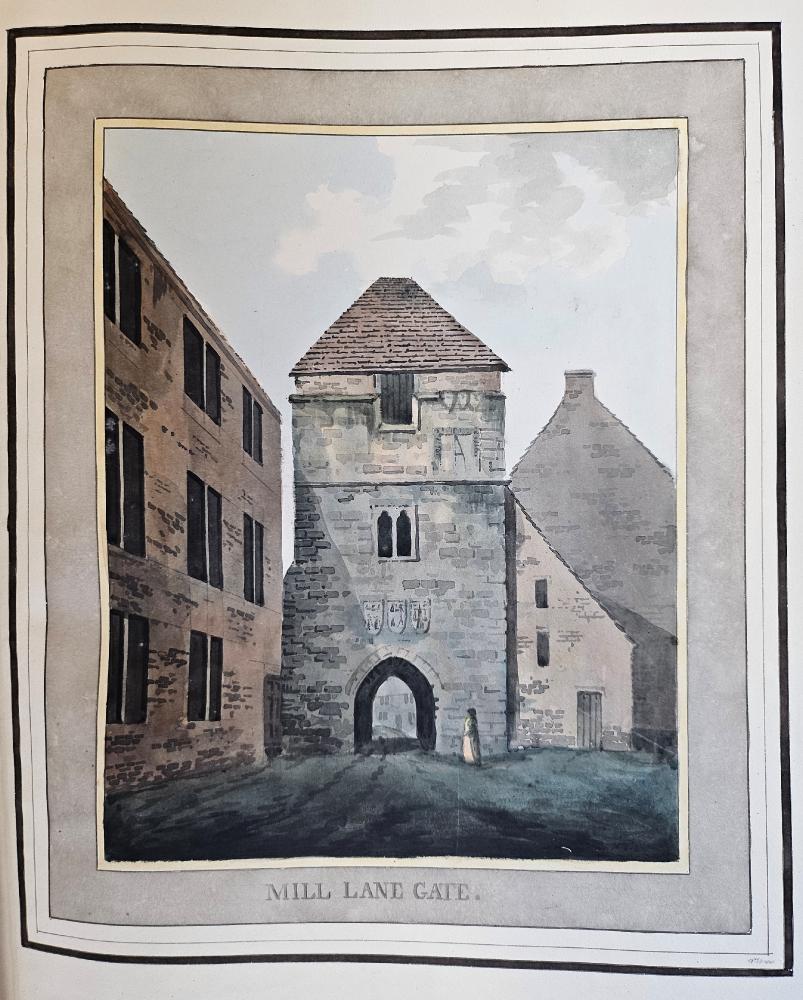 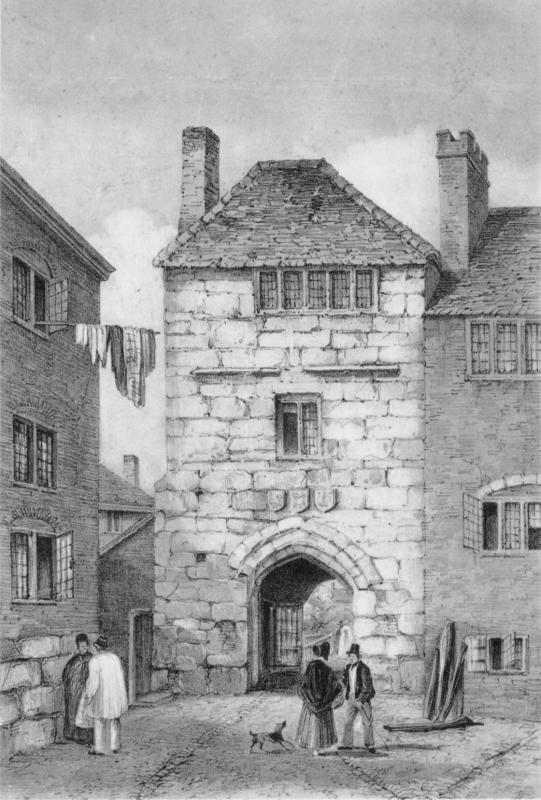
|
|
J. B. Shelton's Archaeology -
Shelton - Cox Street Excavation
|
Annewiggy
Tamworth
|
7 of 7
Mon 22nd Jun 2026 9:24pm
This is the one that my ancestor John Yardley, Mayor owned along with the mill which he inherited from his father Robert in 1659. I will have a look through my information I have from the record office when I have time as I am sure there is some information on the gate house
|
|
J. B. Shelton's Archaeology -
Shelton - Cox Street Excavation
|